
Racine City Directory Holdings
Racine Public Library is the main local doorway to historical directory research. Its genealogy and local-history guide says city directories date to 1858. A reference copy sits on the second floor at call number 917.75 R11, on the center table in nonfiction. The library's equipment rules separately document city-directory microfilm for 1882 through 1960. These statements describe two forms of access, not a promise that every annual edition survives without a gap.
| Collection | Years documented | Where held | Access |
|---|---|---|---|
| Racine city directory reference volumes | Back to 1858 | Racine Public Library, second-floor center table | Reference use; call number 917.75 R11 |
| City-directory microfilm | 1882-1960 | Racine Public Library | Staff-pulled film; readers, scanner, and printer |
| Criss-cross and nearby listings | Exact volume years not verified | Racine Public Library | In-house or limited telephone help |
| Local archival objects | Varies by item | Racine Heritage Museum | Finding aid, archive appointment, and Omeka browse |
Publishers and exact title runs were not verified in official sources, so they should be copied from each volume's title page rather than guessed. The same caution applies to missing years and reverse sections. Confirm the edition at the shelf or with staff before planning a long year-by-year search.
Racine Directory Roots in 1858
The Wisconsin Historical Society's Racine directory note identifies 1858 as the first local directory year. That date fits a larger civic timeline: Gilbert Knapp established the settlement at the Root River mouth in 1834, the village took the Racine name in 1841, and incorporation as a city followed in 1848. A directory published ten years later belongs to an expanding city whose addresses, wards, businesses, and institutions do not map cleanly onto today's layout.
| Year | Racine research marker |
|---|---|
| 1834 | Settlement established at the Root River mouth. |
| 1841 | The village became Racine. |
| 1848 | Racine incorporated as a city. |
| 1858 | First Racine city directory and a four-sheet city map. |
| 1882-1960 | Library's documented city-directory microfilm run. |
The Society's local-history clipping collection has about 16,000 digitized clippings, mostly from 1860 to 1940. A directory name can therefore lead into dated newspaper context soon after the first volume appeared.
Use Racine Directory Shelves
The Racine Public Library local-history page lists the Main Library at 75 7th Street. Main building hours are Monday through Thursday, 9:00 a.m. to 8:00 p.m., and Friday through Saturday, 10:00 a.m. to 4:00 p.m. The History Room requires an appointment and is not an open stack. Rebecca Leannah is the listed contact at 262-636-9255 and Rebecca.Leannah@RacineLibrary.info.
The library's photographed research landing page shows the institutional route for the Racine city directory and its companion genealogy tools.

The page points readers toward local holdings and remote databases, while the physical access rules remain important. History Room material is reference-only and does not circulate. Staff pull microfilm. Cameras, laptops, and scanners are allowed except where an item is marked, and ink pens are not permitted.
Microfilm viewers are first come. A three-hour limit applies only when all machines are busy, and staff can help with the reader, scanner, or printer. Telephone help can include city-directory or criss-cross information and nearby listings. For obituary checks by phone, library policy calls for a local patron and a known date; otherwise the newspaper film is the fallback.
Read a Racine Directory Entry
Exact typography varies by edition, and no live Racine page image was verified in the research. Do not assume that each year prints a phone, occupation, spouse, or owner symbol. Start with the title page and abbreviation key, then transcribe only what the chosen entry shows.
| Name | Surname, given name, and initials exactly as printed. |
|---|---|
| Address | House number, street, direction, unit or business location when present. |
| Status detail | Occupation, business link, spouse, or household notation only if printed. |
| Source control | Publisher, edition year, page, section, and call number or image reference. |
| Order | Alphabetical name list or reverse street section, where that edition has one. |
A directory associates a listed person or business with that edition. It does not prove legal title or uninterrupted residence. A spouse or “widow of” notation can be a strong family-history clue, but it should be paired with a vital record, obituary, cemetery entry, deed, or tax record.
- Criss-cross directory
- A reverse section arranged by street and house number rather than by surname.
- Householder index
- An address-oriented list that can point from a place to the listed person for one edition.
- Abbreviation key
- The volume's own legend for shortened streets, occupations, status marks, and other symbols.
Photograph or copy the abbreviation key before taking notes. That one step prevents a short printed mark from becoming an invented fact.
Trace Families Through Racine Directories
Annual or near-annual editions can fill the long spaces between federal census schedules. A good search retains name variants and full source details while moving one year at a time.
- Choose a confirmed name, address, or census year, then search the closest directory edition.
- Record the full entry, edition, publisher, section, and page. Copy the abbreviation key.
- Check adjacent years for moves, new household notation, a changed business address, or disappearance.
- Use a reverse section, when present, to see who was listed at the old or new address and nearby numbers.
- Pair the sequence with census, deed, newspaper, permit, cemetery, or vital sources, keeping each record's date and role separate.
A missing name has several possible causes. The person may have moved, died, changed a name, been omitted, or lived outside the edition's coverage. Search the address, spouse, business, and alternate spellings before treating absence as an event. When a modern record must confirm a newly found person, the Racine resident lookup uses a different, one-name verification path.
Extend Racine Directories Into News
The Racine Public Library newspaper collection documents local newspaper microfilm from 1838 to the present. It also points to BadgerLink's Archive of Wisconsin Newspapers, Newspapers Source Plus, and Newspapers.com Library Edition World Collection. Those sources can explain a directory change through an obituary, wedding notice, business announcement, school event, or civic activity.
The library newspaper page appears in the project's successful institutional capture.

The screen represents the library's access route, while database rights differ. Ancestry Library Edition is available on library terminals or library Wi-Fi, not as a general home subscription. BadgerLink, HeritageQuest, FamilySearch, and Chronicling America provide other remote or account-based paths.
Note: A newspaper mention can add context, but it does not replace the edition date and page of the directory entry.
Map Racine Directory Addresses
The 1858 Wisconsin Historical Society Racine map has four sheets showing lots, blocks, landowners, buildings, streets, wards, churches, schools, press, and hotels. Its catalog call number is D GX9029 R12 1858 M. The January 1887 Library of Congress Sanborn set has twenty-seven sheets. Together they can translate an old street entry into a lot, block, building footprint, or ward.
Street names and numbering require care. A 1975 regional report counted at least 105 duplicated names and 292 duplicate streets in Racine County and described thirteen numbering systems. The report is evidence of the problem, not proof that all of its proposed fixes were adopted. Keep the municipality, cross street, ward, map sheet, and lot or block beside the old address.
Browse Racine Directory Companions
The Racine Heritage Museum, 701 Main Street, adds photographs, organizations, industry records, family files, and archival leads. Listed museum hours are Tuesday through Friday, 10:00 a.m. to 4:00 p.m.; Saturday, 10:00 a.m. to 3:00 p.m.; and Sunday, noon to 4:00 p.m. The phone is 262-369-3926. Its finding aid should be checked before a research visit, and listed archive access is Tuesday 1:00 to 4:30 p.m. and Saturday 10:00 a.m. to 1:00 p.m.
The museum's Omeka collection provides keyword, Boolean, and exact searching, plus Item, File, and Collection filters.
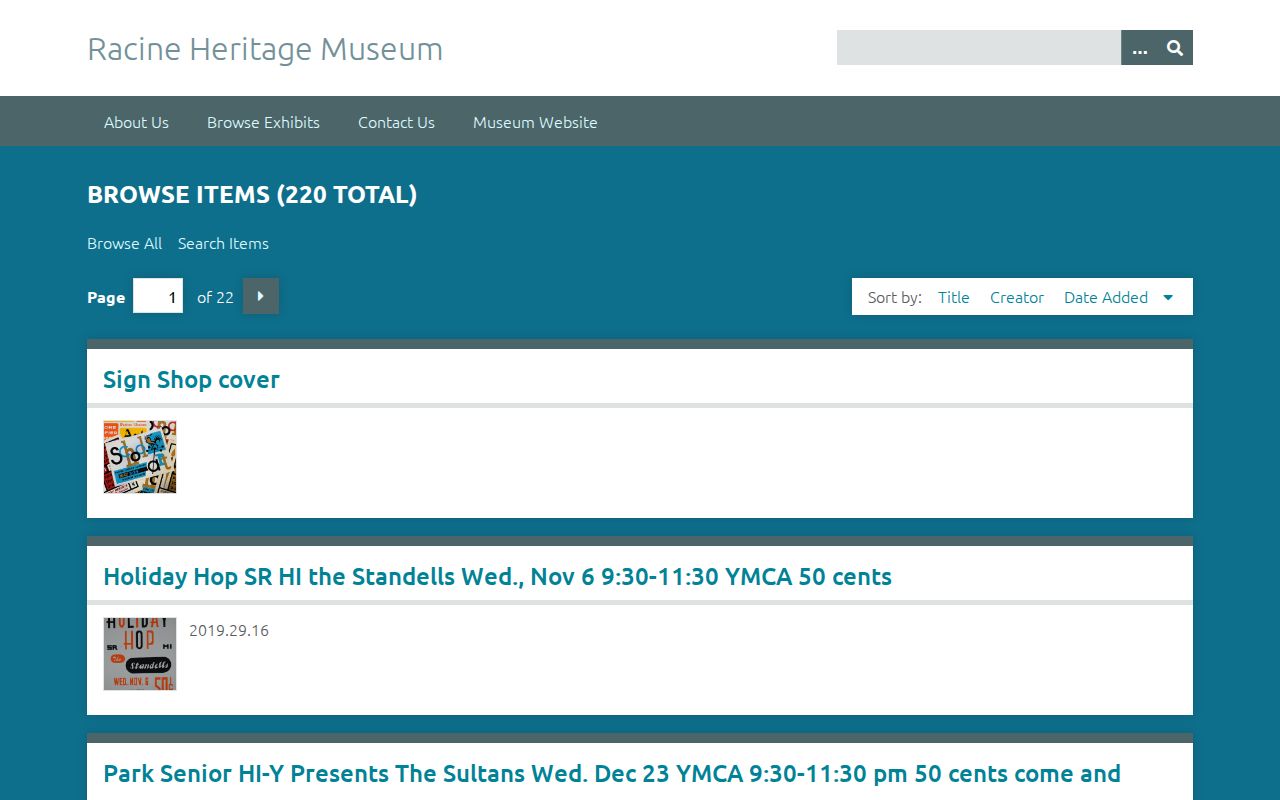
The inspected browse screen showed 220 items and sorting by title, creator, or date added. That public set is a useful lead, not the full museum archive, so the finding aid and direct contact remain part of the access chain.
Racine Directories Enter Digital Work
Recollection Wisconsin described a Racine Public Library digitization effort in July 2025 covering local photographs, maps, yearbooks, city directories, and records. A later feature named Racine High School, Washington Park High School, and William Horlick High School yearbooks. Another cohort description included postcards, church histories and directories, and city directories.
This is a timely access change, but project inclusion does not mean every item is already searchable or downloadable. Racine High School opened in December 1853, closed in 1929, and has yearbooks from 1909, making the yearbook work a strong companion for classmates and school-era names. Check the live collection, then ask library staff about items still being prepared.
Access tip. Give staff a name, approximate year, address, school or church, and desired format. A focused request is easier to match to an edition or archival file.
Verify Racine Directory Evidence
A city directory is strongest when used for the claim it supports: a person or business was listed with certain text in a certain edition. Ownership requires a deed or assessor record. A death calls for a certificate, obituary, or cemetery source. A structural change may call for a permit, Sanborn sheet, or Wisconsin Historical Society property file. Each record has its own date and custodian.
For a modern by-address investigation, the Racine street directory explains the assessor, county GIS, tax, and deed chain. Historical work stays with the shelf, film, maps, newspapers, and archives. Keeping those roles apart prevents a reference-only directory entry from being mistaken for a current address or legal ownership record.
When the web ends, phone the library, book the History Room, use the microfilm readers, consult the Historical Society search, or contact the museum archives. Exact reproduction fees were not located in the research, so ask the institution before ordering copies.